Documenting the Signs and Sign Painters of Bursa, Turkey
YazıBursa is a living digital archive of Bursa’s hand-painted signs and vernacular lettering.
In last week’s ‘BLAG 09 Digital Companion’ I mentioned that there was more to come from Murat Ertürk and his ongoing work documentating the hand-painted signs and sign painters from Bursa, Northwest Turkey. Here he introduces the digital archive, YazıBursa (The Lettering of Bursa), that he has developed with his brother.
YazıBursa: A Living Archive of Bursa’s Vernacular Lettering
By Murat Ertürk
Bursa was the Ottoman Empire’s capital and carried the commercial, architectural and cultural legacy of that era into the centuries that followed. Its position on the Silk Road ensured it continued as one of the region's centres of trade, craft and art, while the city’s major Ottoman mosques helped sustain a strong tradition of calligraphy.
After the Republic was declared, the adoption of the Latin alphabet in 1928 created an enormous demand for new signage, much of which was produced by local sign painters and calligraphers. In the years between the alphabet reform and the rise of computer-aided production, Bursa was home to a large number of highly skilled sign painters.
Most of those painters are no longer working, and most of their work was never recorded anywhere. When a painter dies, or the last person who knew them does, whatever was known about them also tends to disappear. When a shop closes or its sign is replaced, that handiwork is usually erased without a trace, and with no record of who made it.
YazıBursa is an antidote to the precarious nature of these histories, capturing the traces before they are lost forever. Founded in 2021 by my brother Emre Ertürk and I, it takes the form of a growing online archive. So far, this documents well over 300 signs, with each one geolocated and categorised. The aim isn't just to photograph what's left, but to record everything that can be learned about the signs and, importantly, their creators. These currently consist of nearly fifty sign painters, identified via the names they signed their work with.
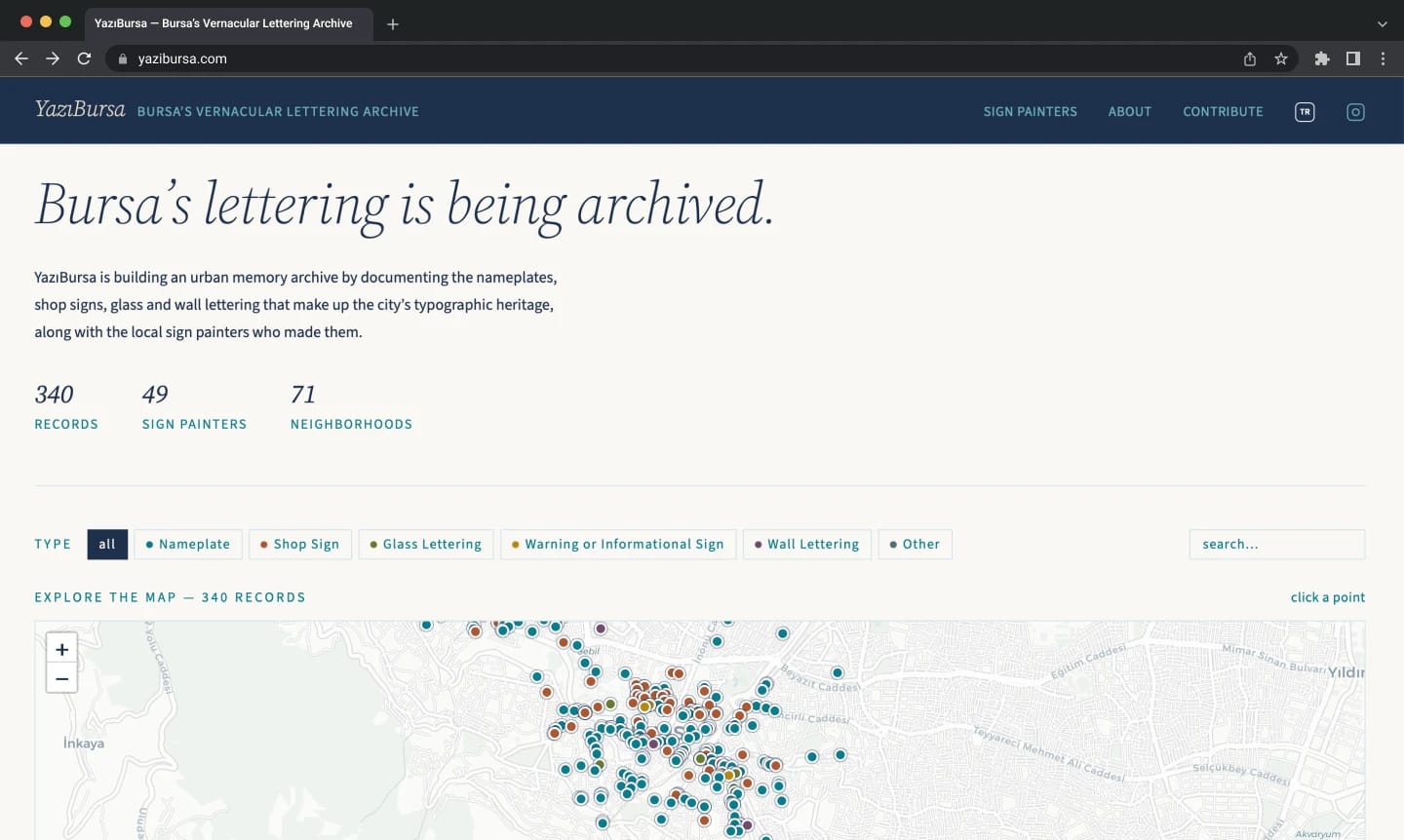
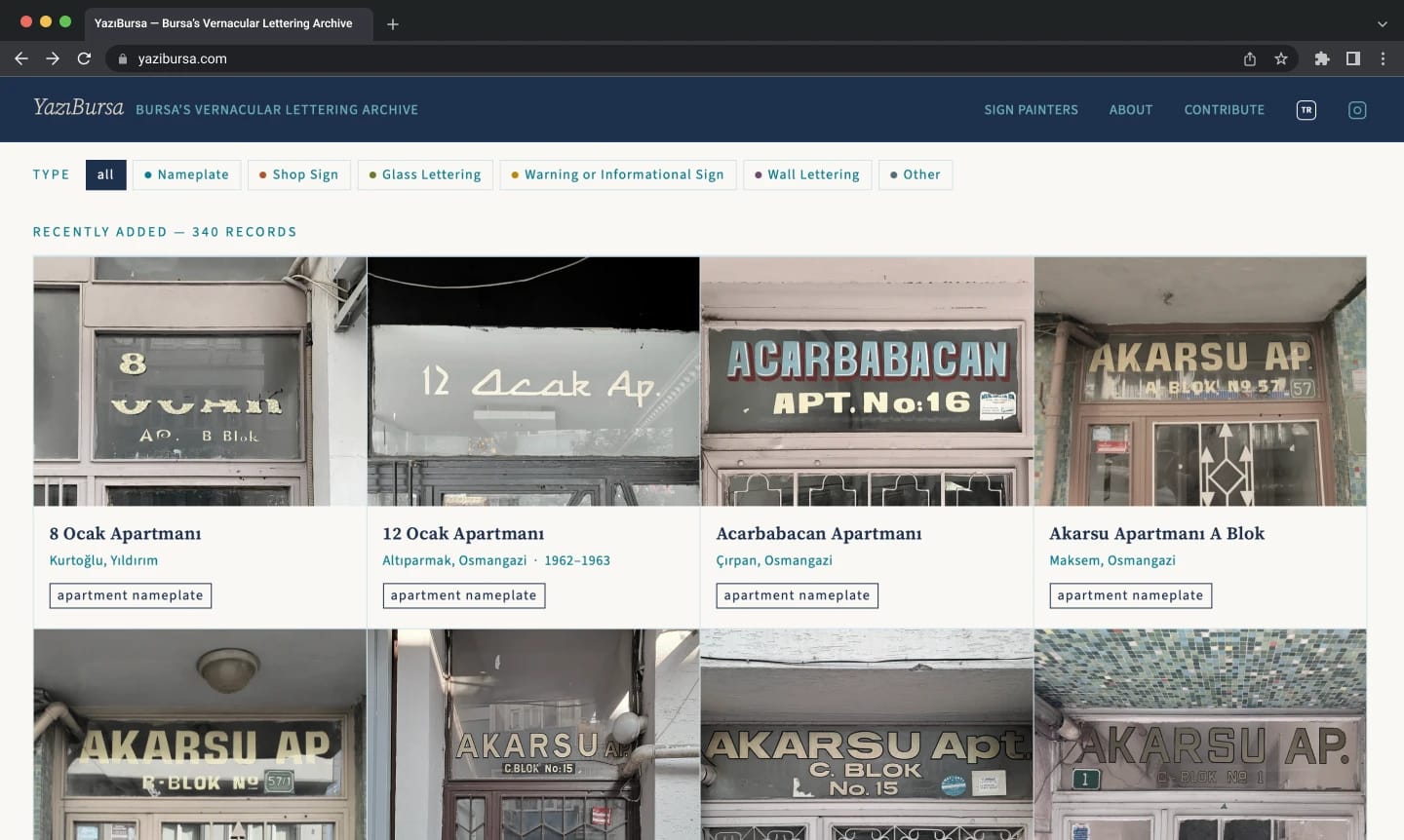
YazıBursa's vital statistics and map greet visitors to the archive. The homepage also houses the library of documented signs, with the most recent additions towards the top.
There are a few ways to explore the archive. The first thing you see is the current inventory figures. From there, you can browse by six categories of sign: nameplates, shop signs, glass lettering, warning or information signs, wall lettering, and other. Or you can explore directly via the map, seeing where signs are found in the city, including those areas where Bursa's vernacular lettering is most concentrated.
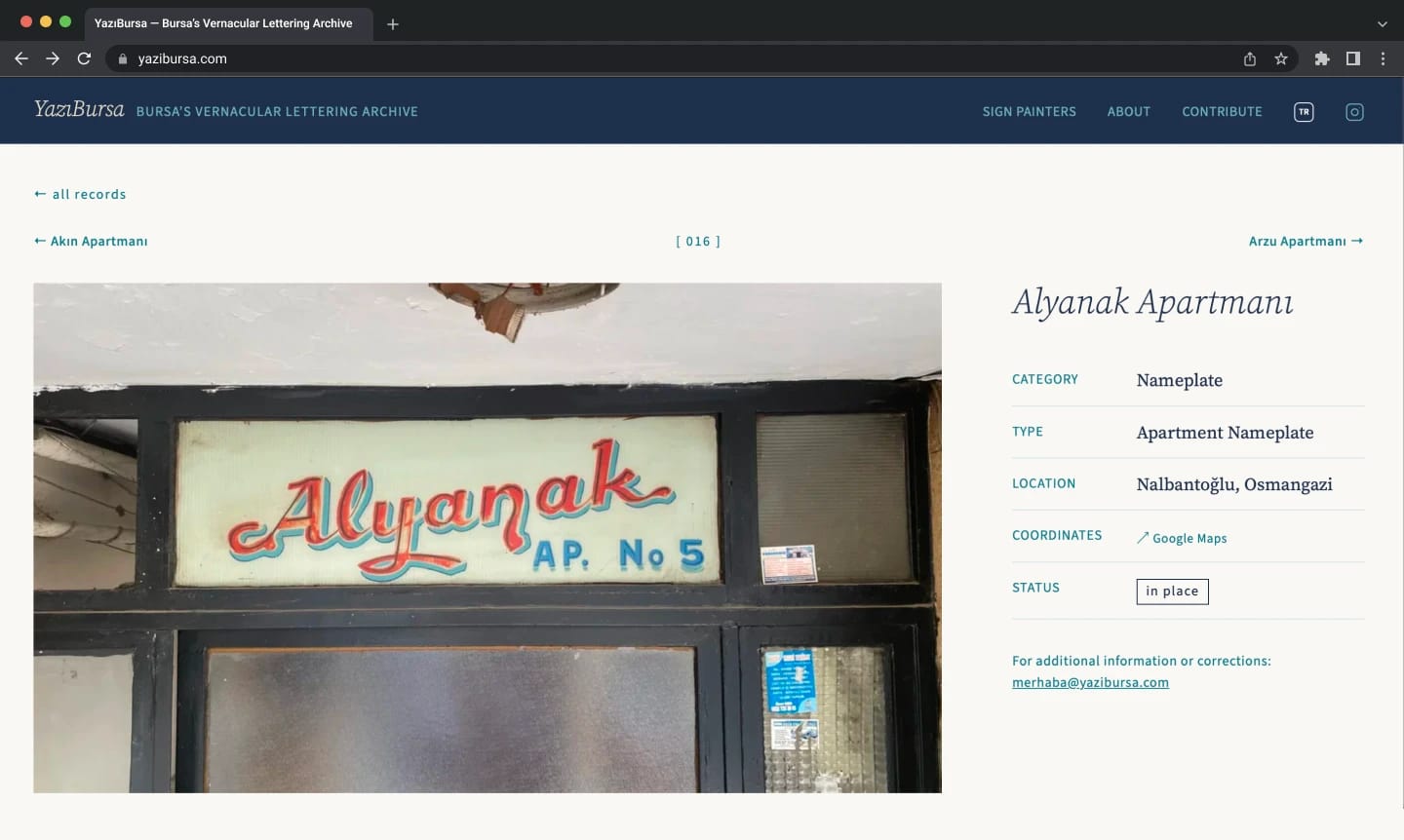
Every record has its own detail page, listing the category, type, district and neighbourhood, the painter’s name where known, the year it was made, precise coordinates, whether it is still in place, and the name of the contributor, where applicable. The names and coordinates inside a detail page double as gateways: click a painter’s or contributor's name and every piece linked to them appears; click the coordinates and you're taken straight to that spot on Google Maps.
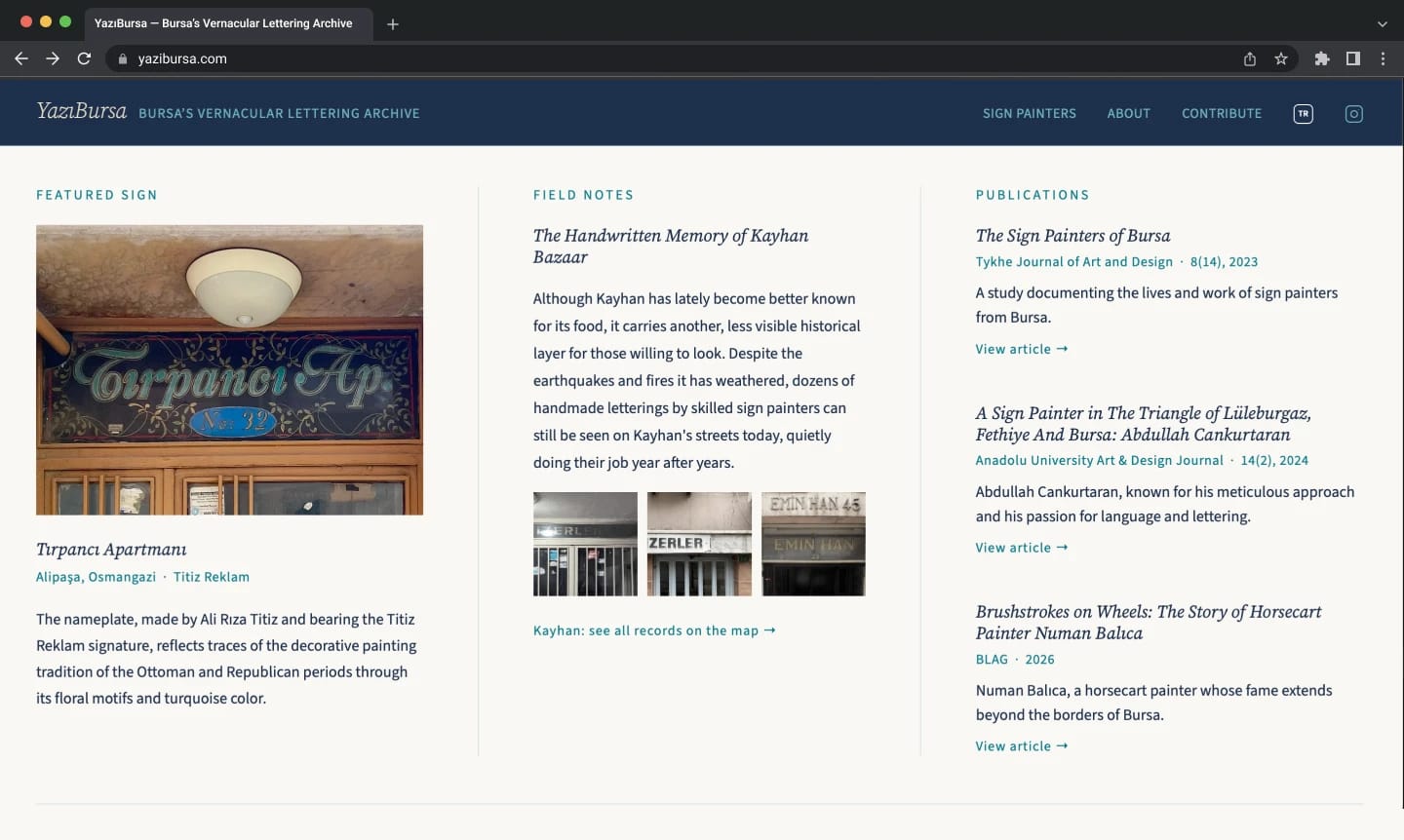
If you prefer to just browse, then you can quickly move from one record to the next using the left and right arrow keys. The homepage also carries an editorial layer — Featured Sign, Field Notes, and Publications — which can also be followed through a free newsletter.
The Sign Painters page then features nearly fifty names, gathered from signatures found on the signs themselves, oral history interviews, and literature reviews. The list gives known details for each person, including their name, dates of birth and death, the name of their workshop, and the number of documented signs attributed to them.
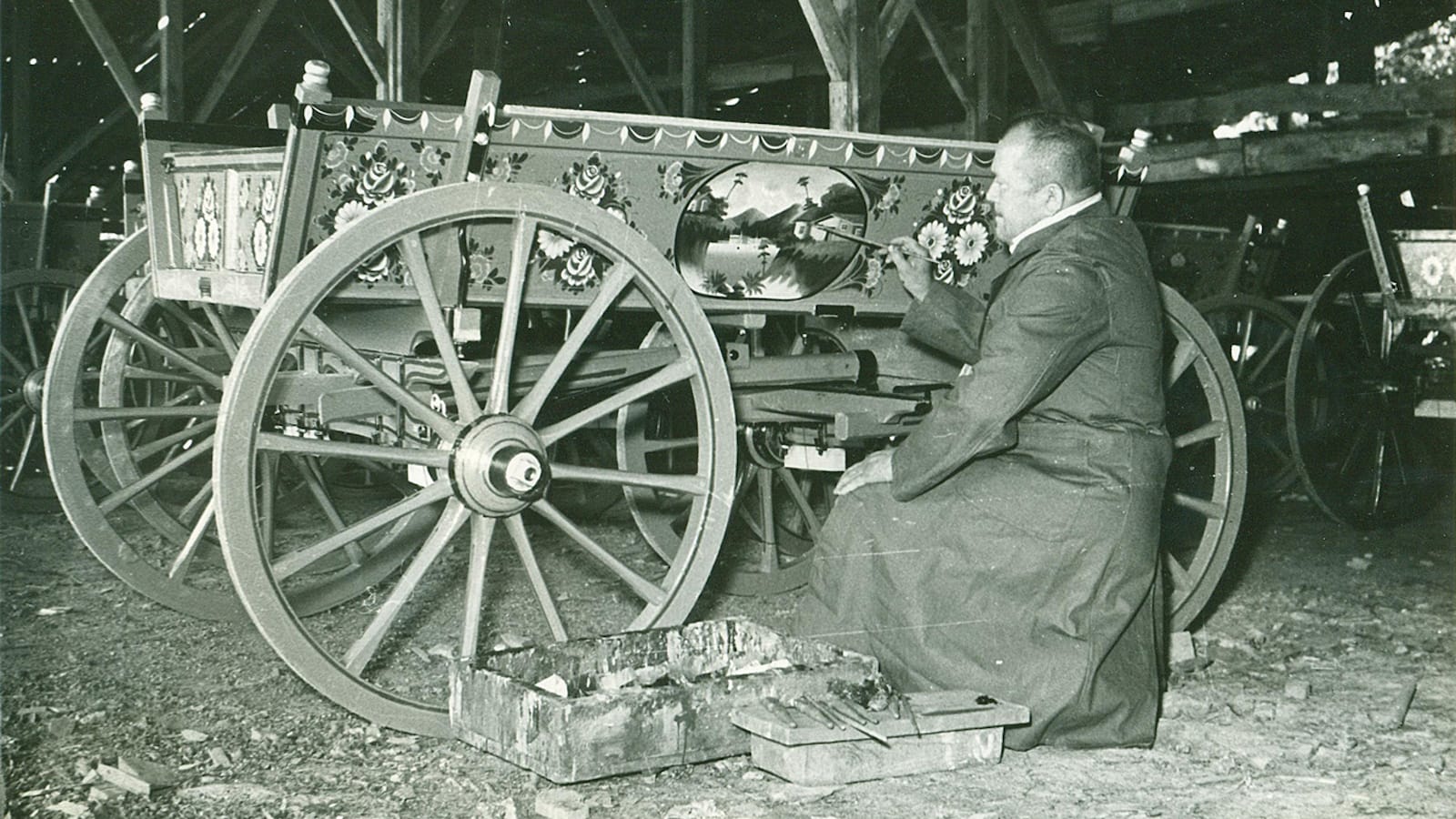
Despite being born in Bursa, Numan Balıca spent his working life elsewhere. However, his son, Mesut, is among the sign painters on the YazıBursa archive. Check out the full Balıca story in this bl.ag online piece.
Here I’ve highlighted three signs from the archive, and hope that these inspire you to explore even more of what Bursa and its former sign painters have to offer.
Sema Apartment
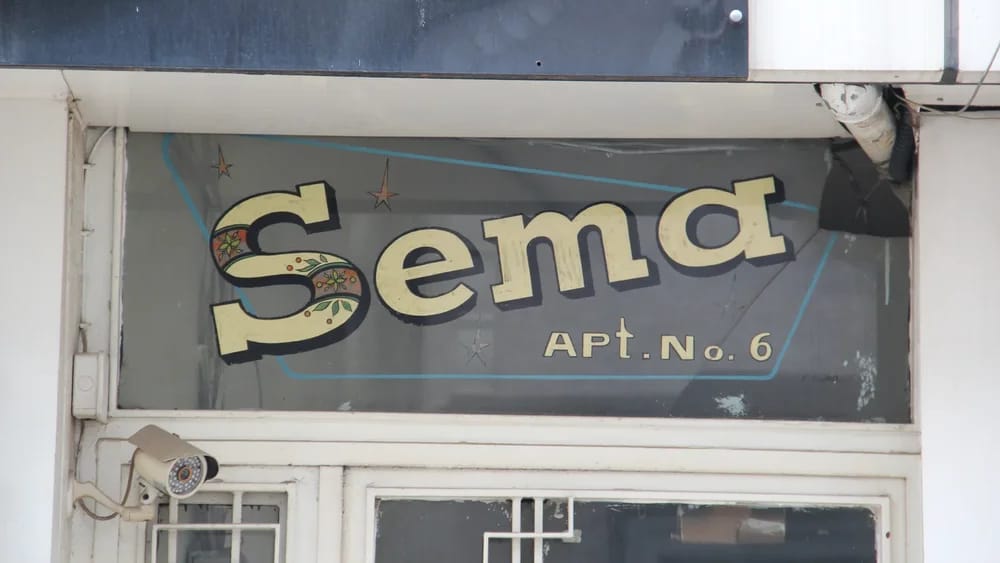
The nameplate of Sema Apartment, made by Feridun Gürbüz, features floral motifs painted onto the body of the S. The whole word sits inside a blue line tracing the outline of a sky scattered with stars. On closer inspection, it becomes apparent that the sign painter has depicted a sky within the sign, as 'Sema' means 'sky' in Turkish. Decades on, it's still doing its job, turning the city into an open-air gallery for anyone willing to look up and notice what's usually invisible.
What's more, it isn't alone. The building next door carries another nameplate, by a completely different painter. A sign painter’s portfolio isn’t kept in a folder or compressed into an image on a webpage; every job left standing on the street is part of the portfolio. These two nameplates, unintentionally or not, turn the stretch of street between them into a side-by-side display of skill, as if Gürbüz were competing with the painter working right next door.
Rahman Apartment
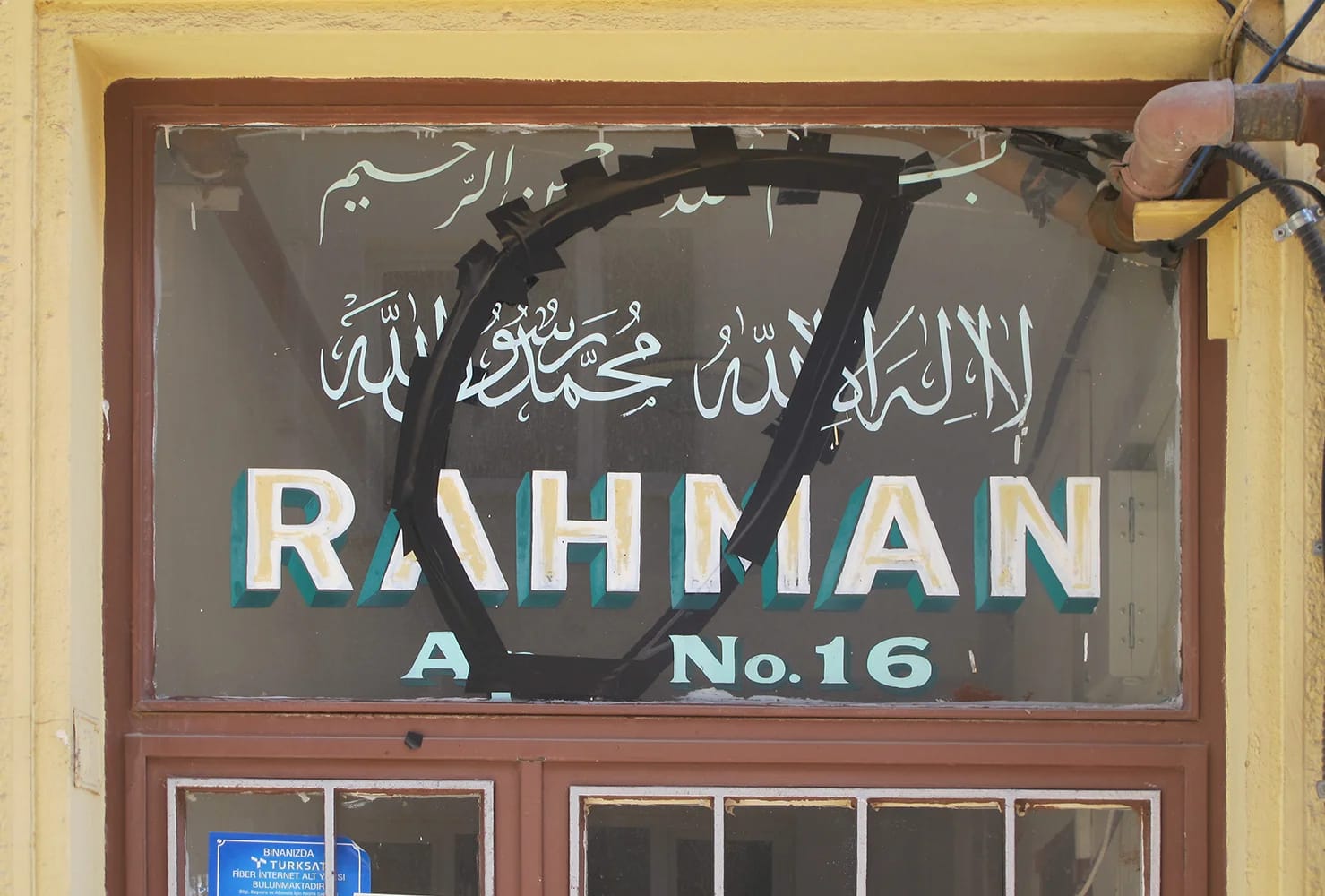
This nameplate for Rahman Apartment features Arabic calligraphy, which is a common sight in many places in Turkey, including workplaces, apartment entrances, and homes. However, it is rare to find it on nameplates. That's exactly what makes this one stand out: the building name in Latin letters and Arabic calligraphy featuring religious inscriptions sit side by side, bringing two writing traditions together in the same place. But the cracked glass, held together with black tape, is a reminder of just how precarious that craftsmanship's survival is. YazıBursa can record this typographic heritage digitally, but its physical survival is, for the most part, down to chance.
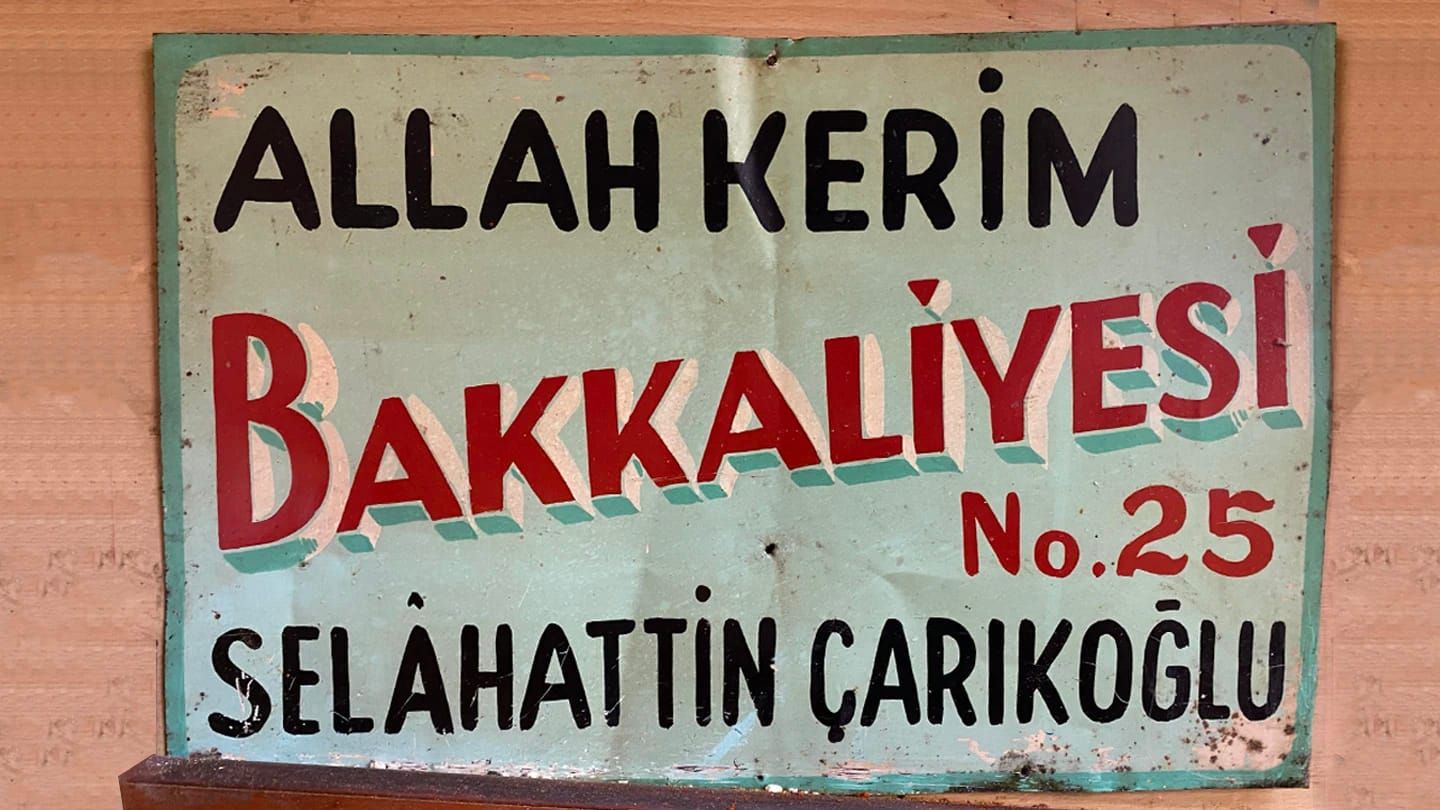
The sign painter who made the Rahman Apartment’s nameplate may have been familiar with the Arabic script, and that's likely no coincidence. He may have had a background in calligraphy, like others from a generation of sign painters whose working lives spanned the transition from Arabic script to the Latin alphabet — many calligraphers in Bursa lived through that same transition. Rewriting the city's signage at the time generally fell to the region's local painters and calligraphers. The sign of Allah Kerim Bakkaliyesi (grocer), in Tuzpazarı, central Bursa, carries the trace of exactly that transition.
Allah Kerim Bakkaliyesi
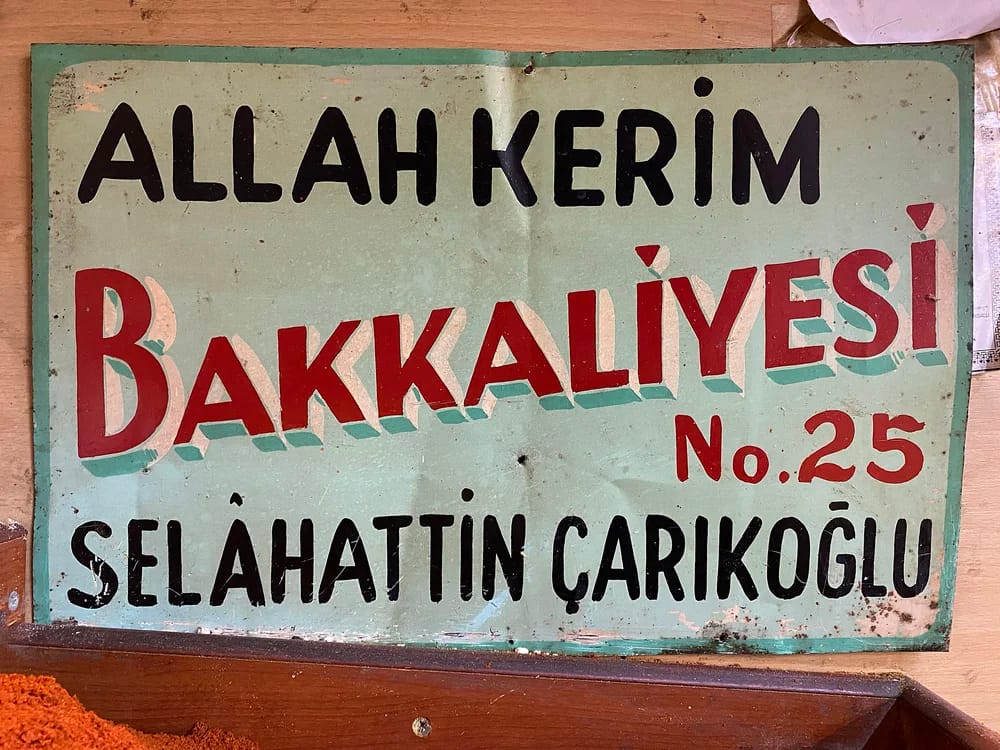
This sign was produced by the calligrapher Mehmet Haris Öncel (1924–2002), who trained under two accomplished Bursa calligraphers, Hamdi Doğuş and Sami. He opened his first shop in 1945 and continued working until his death in 2002. The grocer’s sign is his and, with its single-stroke lettering, colourful background, and three-dimensional letters, still retains its vibrancy.
A Living Archive
The signs and sign painters documented so far are just the visible edge of a much larger unknown. Given the size of Bursa, no one really knows how many names and signs are yet to make it onto the map; not every neighbourhood has been surveyed, not every story recorded. However, we welcome contributions from the public in our ongoing efforts.
Anyone who shares a photograph of a sign, the name of a painter, or a story leaves their own name on the record too. It's this constant participation that turns YazıBursa from a static database into a living archive. And each one of these small contributions helps in closing the gap between the known and the unknown, constantly enriching the story of Bursa’s signs and its sign painters.
More Projects
 Better Letters